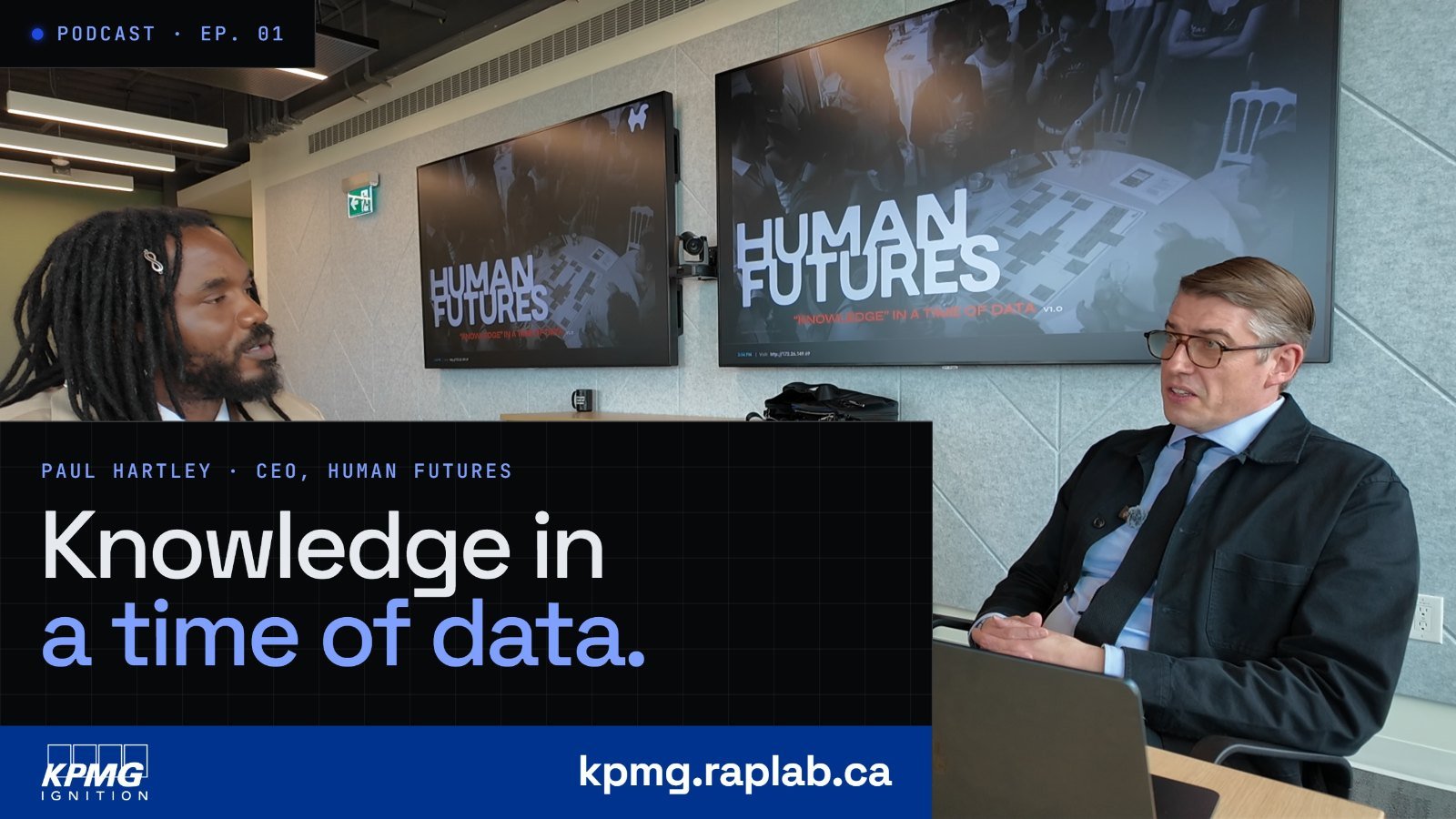
The first episode of the KPMG Ignition Lab Show features Paul Hartley, CEO of Human Futures, a strategy and research firm that helps organizations understand people and plan for what comes next. Paul joined us at the KPMG Ignition Lab at McMaster University to open the fall speaker series, and sat down afterwards for this conversation on research, data and where insight is heading.
Why this conversation matters now
Organizations have never had more data. Dashboards, analytics platforms and now generative AI can produce numbers and summaries on demand. Yet many teams still struggle to answer the questions that matter most: why customers behave the way they do, what employees actually need, and which signals point to real change rather than noise.
That gap between data and understanding is the core of Paul’s work, and the thread running through this episode.
Research as the sensory apparatus of an organization
In his talk at the lab, Paul framed research as the sensory apparatus of an organization: the way a company sees, hears and makes sense of the world around it. On that view, research is how an organization stays in contact with reality, not a one-off project or a box to tick before a launch.
Research is the sensory apparatus of an organization.
If research is how an organization senses, then weak research leaves it effectively numb, reacting late to shifts in customers, markets and culture.
Knowledge in a time of data
The episode returns often to the difference between data and knowledge. Data tells you what happened. Knowledge explains why, and what it means for the decisions in front of you. Getting from one to the other takes interpretation, context and judgment, which is where qualitative research earns its place alongside quantitative analysis.
We discuss:
- How qualitative and market research are practised inside industry today
- Why interviews, observation and ethnographic methods still matter when quantitative data is abundant
- How researchers turn raw material into insight that leaders can act on
- What changes for research teams as AI tools enter the workflow
- The skills students and early-career researchers should build to work in this space
What it means for researchers and students
For those of us working in information systems, design science and human–technology interaction, the conversation is a useful reminder that methods are only half the job. The other half is synthesis: making sense of what you have found and communicating it so an organization can respond. That theme continues later in the series, when Dr. Shane Saunderson speaks on Making Sense of Sensemaking: synthesis in Design Thinking.
Watch the full episode
The full conversation is above. If you work in research, strategy or innovation, or you are a student deciding where to take your research skills, this one is worth your time.
The KPMG Ignition Lab Show records conversations and talks from the KPMG Ignition Lab at McMaster University’s DeGroote School of Business. Upcoming sessions and recaps are at kpmg.raplab.ca.